How loud is it, really?
Measure the noise around you in dBA, right here in your browser. See the minimum, average and maximum, and where your reading sits on the decibel scale, from a whisper to a jet engine.
- No sign-up, no download
- Audio never leaves your device
- A and Z weighting, Fast and Slow
Uses your microphone. Nothing is recorded or sent anywhere.
Calibrate
Browsers can’t know how sensitive your microphone is. If you know the real level (from a sound level meter or the app), nudge the reading to match. Saved in this browser only.
Where your reading sits
Tap a sound to see how loud it is- Safe · under 65 dB
- Caution · 65–85 dB
- Risk · over 85 dB
How loud is…
Everyday sounds on the same scale, with what each level means for your hearing.
A library, a quiet residential street at night.
How loud is 40 dB → Safe 60 dBA normal conversation at 1 m, background music in a café.
How loud is 60 dB → Risk 85 dBHeavy traffic, a food blender.
How loud is 85 dB → Risk 110 dBA rock concert near the speakers, a chainsaw.
How loud is 110 dB →Classroom noise monitor
Put it on the projector. Colourful balls bounce higher as the room gets louder, and the screen tells the class when it is too loud.
Open the monitor →Record, film and track your noise dose
Saved sessions with charts and location, video with the level on screen, OSHA and NIOSH dosimeter, A/C/Z weighting and an Apple Watch app.
Download on the App Store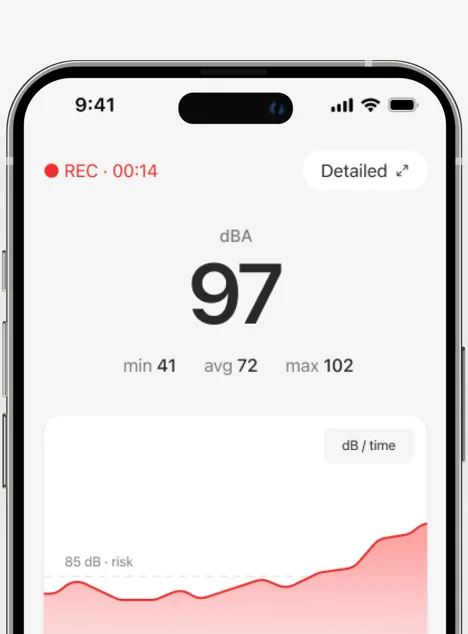
How the online decibel meter works
Your browser hands the page a stream of raw audio from the microphone. Many times a second the meter measures how much energy is in that audio, applies A-weighting so that bass rumble and high hiss count the way they do for human ears, and smooths the result with the standard Fast (125 ms) or Slow (1 s) response. That gives the large number.
The average is an energy average (Leq), the same way professional meters work. It is pulled up by loud moments much more than a simple average would be, which is why a few door slams can raise it noticeably.
How accurate is it?
Phones and laptops apply different amounts of gain to their microphones and the browser can’t read it, so every online meter has to guess the conversion from digital level to real sound pressure. Expect the reading to be in the right range for everyday noise, and use Calibrate if you can compare against a known level. Very quiet rooms (below about 30 dB) and very loud sounds (above about 100 dB) are outside what most built-in microphones can measure.
If you need numbers you can rely on, for a noise complaint, a workplace or a venue, use a calibrated meter or the Decibel Meter app, which is calibrated for each iPhone model and keeps a record you can export.
Questions
Is this online decibel meter free?
Yes. It runs in your browser with no sign-up and no download. Press Start measuring and allow the microphone.
How accurate is a decibel meter in the browser?
It is a good estimate, usually within a few decibels for everyday sounds, but browsers don’t know how sensitive your microphone is, and laptop microphones vary a lot. Use Calibrate to match a known reference. For readings you need to rely on, use a calibrated sound level meter or the Decibel Meter app, which is tuned per iPhone model.
Does the meter record or upload my audio?
No. The audio is turned into a number on your device many times a second and thrown away. Nothing is stored and nothing is sent to a server.
What does dBA mean?
dBA is a sound level with A-weighting, which turns down very low and very high frequencies the way human hearing does. Most noise limits are written in dBA. Switch to Z to see the unweighted level.
What noise level is safe?
Below 70 dB is safe for any length of time. From 85 dB, NIOSH recommends limiting exposure to 8 hours a day, halving the time for every 3 dB more. At 100 dB the safe limit is about 15 minutes.
What is the difference between Fast and Slow?
Fast averages over 125 milliseconds and follows short bursts such as a door slam. Slow averages over 1 second and is easier to read for steady noise such as traffic or an air conditioner.