How Loud Is Too Loud? Safe Decibel Levels and Hearing Damage
Hearing risk starts at 85 dB. See safe daily times for each level under NIOSH and OSHA, the warning signs of damage, and safer limits for kids.
85 dB on the decibel scale
Tap a sound to compare- Safe · under 65 dB
- Caution · 65–85 dB
- Risk · over 85 dB
The short answer: sound becomes risky for your hearing at around 85 dB, if you are exposed to it for a long time. Below 70 dB, sound is not known to damage hearing no matter how long it lasts. Above 85 dB, the safe time drops quickly, and at 120 dB and up, harm can happen in seconds.
What matters is not only the level but how long you are exposed to it. A blender at 85 dB for a minute is harmless. The same level for a full working day, every day, is how most noise-induced hearing loss happens.
The two rules: NIOSH and OSHA
In the United States, two organisations set the numbers most people quote.
NIOSH (the National Institute for Occupational Safety and Health) publishes a recommended exposure limit: 85 dBA for 8 hours, with a 3 dB exchange rate. Every 3 dB increase halves the safe time. This is based on the physics of sound energy, because +3 dB means twice the energy reaching your ears. Hearing scientists and the CDC treat NIOSH as the health-based guideline.
OSHA (the Occupational Safety and Health Administration) sets the legal limit for US workplaces: 90 dBA for 8 hours, with a 5 dB exchange rate. Every 5 dB halves the allowed time. OSHA also has an “action level” of 85 dBA averaged over 8 hours: at that point employers must run a hearing conservation program with hearing tests and protection.
The OSHA rule is a legal minimum, not a safety guarantee. NIOSH estimates that a noticeable share of workers exposed to 90 dBA for a whole career will still develop hearing loss, which is why its own limit is stricter. If you are deciding what is safe for yourself, use the NIOSH numbers.
Both agencies agree on one ceiling: no unprotected exposure to impulse noise above 140 dB peak, such as a gunshot.
Safe listening time by decibel level
| Level | NIOSH safe time per day | OSHA allowed time per day | Sounds like |
|---|---|---|---|
| 85 dB | 8 h | No limit (action level) | Heavy traffic, blender |
| 88 dB | 4 h | No limit | Loud restaurant kitchen |
| 90 dB | 2.5 h | 8 h | Gas lawn mower |
| 91 dB | 2 h | 7 h | Subway train |
| 94 dB | 1 h | about 4.5 h | Power drill |
| 95 dB | 47 min | 4 h | Motorcycle |
| 97 dB | 30 min | 3 h | Loud bar |
| 100 dB | 15 min | 2 h | Earbuds at full volume |
| 103 dB | 7.5 min | about 80 min | Nightclub |
| 105 dB | about 5 min | 1 h | Stadium crowd |
| 110 dB | about 1.5 min | 30 min | Rock concert, chainsaw |
| 115 dB | about 30 s | 15 min | Loud concert near the stage |
| 120 dB | about 9 s | Not permitted | Siren up close, thunder |
OSHA’s table stops at 115 dBA for continuous noise. For the full scale with everyday examples, see the decibel chart, and for gunshots, jet engines and concerts, the loudest sounds list.
These times add up across the day. Half an hour of 97 dB music plus an hour of 94 dB power tools is already a full day’s dose under NIOSH. A noise dosimeter, or a meter app with a dose readout, does this sum for you.
What counts as safe below 85 dB
Most of daily life sits well below the risk zone:
- 60 dB: a normal conversation. Safe for any length of time.
- 70 dB: a vacuum cleaner or a busy road. The US EPA has named 70 dB averaged over 24 hours as the level that protects hearing over a lifetime.
- 80 dB: an alarm clock or a garbage disposal. Fine in short bursts. The WHO safe-listening standard allows adults about 40 hours a week at this level.
Loud does not have to mean harmful. Noise at 65 to 80 dB can be tiring, stressful and bad for sleep without damaging the ear itself. The neighbor noise guide covers that side of the problem.
How noise damages hearing
Inside the inner ear, thousands of tiny hair cells turn vibration into nerve signals. Loud sound overworks and bends them. After a short, loud exposure they can recover, which is the muffled feeling after a concert that fades by the next day. Repeated or extreme exposure kills them, and in humans they do not grow back. That loss is permanent.
Noise-induced hearing loss usually starts in the higher frequencies, around 3 to 6 kHz. That is where consonants like “s”, “f” and “th” live, so the first thing people notice is that speech sounds mumbled, especially in a noisy room.
Warning signs
- Ringing, buzzing or hissing in your ears (tinnitus) after noise.
- Muffled hearing after leaving a loud place.
- You have to shout to be heard by someone an arm’s length away. NIOSH uses this as a rule of thumb: if you need to raise your voice at that distance, the level is probably above 85 dB.
- Trouble following conversations in restaurants or groups.
- Turning the TV up higher than others in the room want it.
If symptoms last more than a day, or come on suddenly, see an audiologist or doctor. Sudden hearing loss in particular needs prompt attention.
Children and hearing
Children’s ears are more vulnerable, and children cannot always tell you when something is too loud. The WHO safe-listening standard uses a lower weekly allowance for children and other sensitive listeners: 75 dB for 40 hours a week, compared with 80 dB for adults.
Practical points for parents:
- Many children’s headphones cap volume at around 85 dB. That is a useful safety net, not a reason to listen for hours.
- Fireworks, cap guns and squeaky toys held to the ear can reach levels well over 100 dB.
- Ear defenders sized for children are worth carrying to concerts, motor races and fireworks displays. Babies are best kept away from these events entirely.
- Judge a noisy toy at the distance your child actually holds it, which is often right next to the ear. ASHA publishes guidance on loud toys and recreational noise for parents.
Headphones and earbuds
Personal audio is the most common source of long, loud exposure, because it is easy to listen for hours. Many phones can drive earbuds to around 100 dB, which NIOSH would allow for only 15 minutes a day.
Simple habits help:
- The 60/60 rule: no more than 60% volume for no more than 60 minutes at a time, then take a break.
- Use noise-cancelling headphones on trains and planes. Most people turn the volume up to cover background noise, and cancelling removes the need.
- Check your phone’s own figures. On iPhone, the Health app records headphone audio levels, and Settings > Sounds & Haptics > Headphone Safety can reduce loud audio automatically. Our iPhone measuring guide explains these tools.
- If someone next to you can hear your music clearly, it is too loud.
How to protect your hearing
- Turn it down. Every 3 dB lower doubles the safe time.
- Move away. Doubling your distance from a sound source cuts the level by up to 6 dB outdoors.
- Limit time. Take quiet breaks during long loud activities.
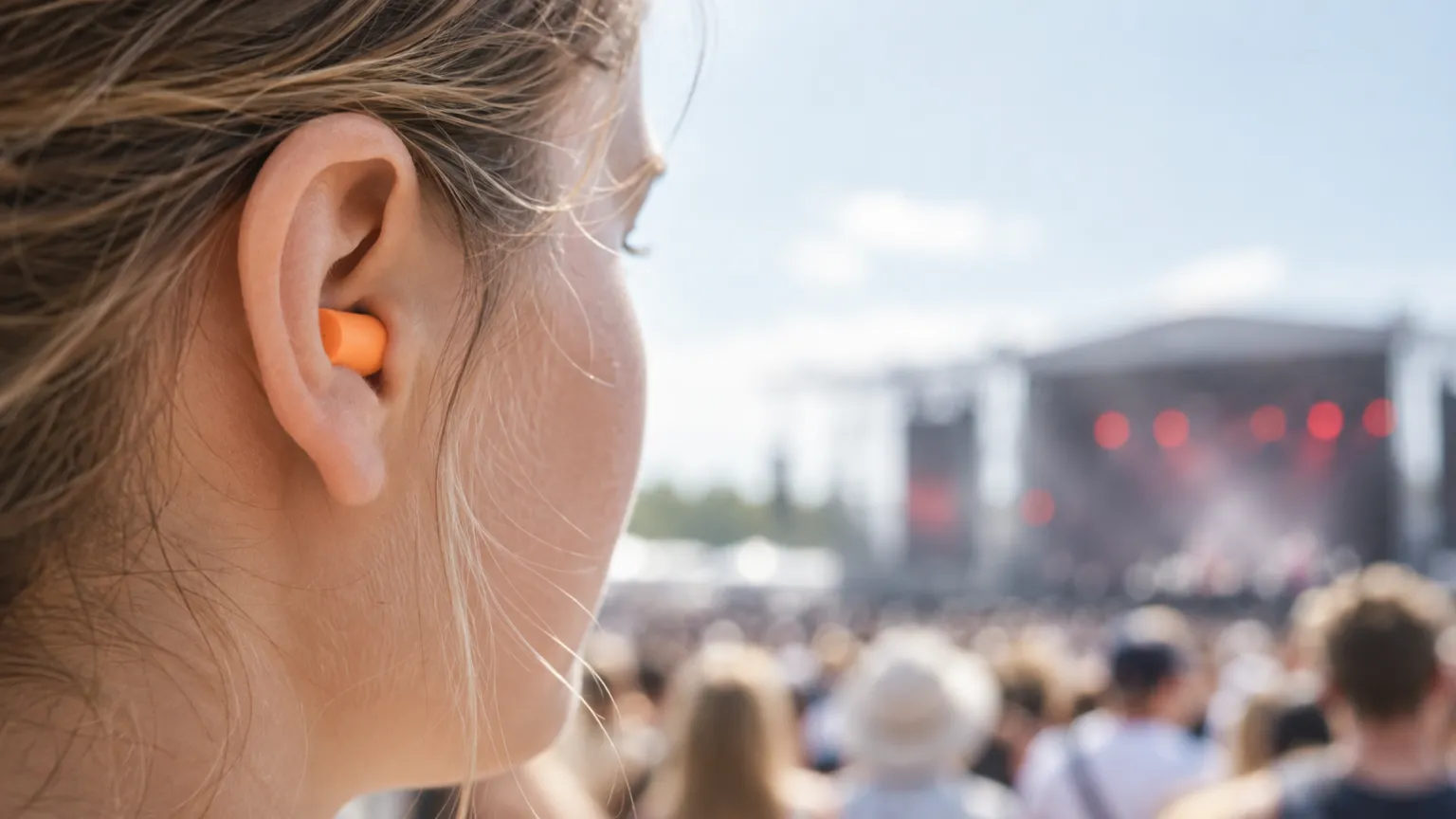
- Wear protection. Foam earplugs, fitted properly, reduce sound by roughly 15 to 30 dB. Musicians’ earplugs lower the level more evenly so music still sounds natural.
- Measure. It is hard to judge levels by ear, especially after a while in a loud place, because your ears adapt. A quick reading tells you which zone you are in.
You can check any room right now with the free meter on our home page, which runs in your browser.
Measuring your own exposure
Decibel Meter: dB Sound Level for iPhone and Apple Watch shows the live level in dBA, tracks min, average (Leq), max and peak during a session, and calculates a noise dose based on NIOSH and OSHA rules so you can see how much of a safe day you have used. A phone is not a certified instrument, but it is a good way to spot the places and habits that push you over 85 dB. The app is free to download, and live measuring is part of the subscription. See what the app does.