dB vs dBA: What A-Weighted Decibels Mean
dBA is a decibel reading filtered to match human hearing. How A, C and Z weighting differ, when each is used, and what Fast, Slow and Leq mean.
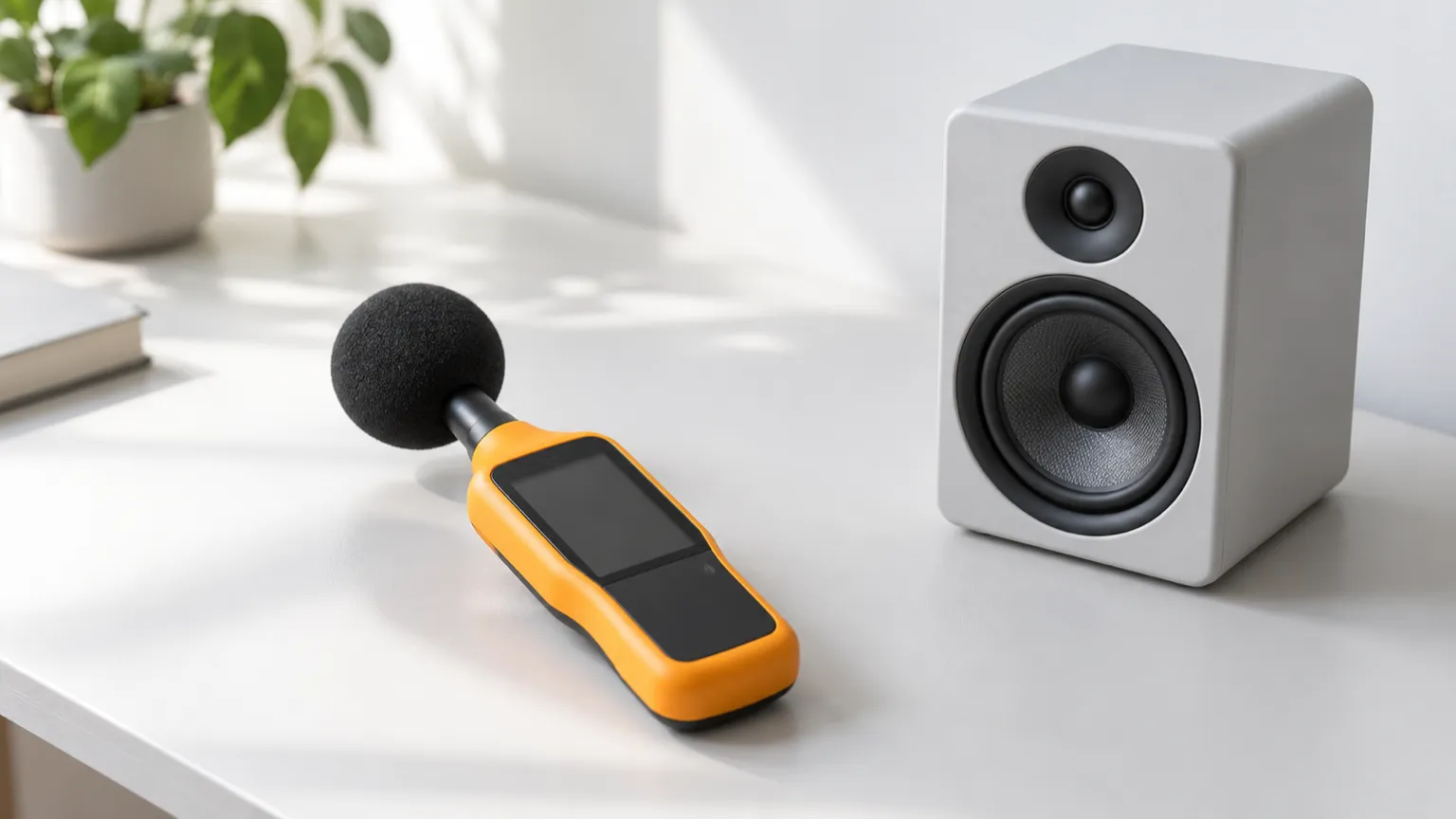
dBA means decibels measured with A-weighting: a filter that turns the low and very high frequencies down before the level is calculated, so the number matches how loud a sound seems to the human ear. A plain dB reading, in contrast, counts every frequency equally.
For most everyday sounds the difference is small. For sounds with a lot of bass, such as engines, music or a neighbor’s subwoofer, it can be 10 dB or more. That is why a reading without its weighting letter is only half the story.
Why weighting exists
Your ears are not equally sensitive to all pitches. They are most sensitive between about 1 and 5 kHz, the range of speech consonants, a baby’s cry and most alarms. They are much less sensitive to deep bass. A 50 Hz hum has to carry far more energy than a 2 kHz tone to sound equally loud.
A microphone has no such bias. Without weighting, a meter would rate a low rumble as loud even when people barely notice it. Weighting curves correct for that. They are defined in the international standard for sound level meters, IEC 61672.
A, C and Z weighting
A-weighting (dBA)
A-weighting follows the ear’s sensitivity at moderate listening levels. It cuts low frequencies heavily and trims the very top slightly.
Used for: almost everything involving people. Workplace limits from OSHA and NIOSH, WHO guidelines, community noise rules, classroom standards and product noise ratings are all in dBA. When someone quotes a decibel figure without a letter, they usually mean dBA.
C-weighting (dBC)
C-weighting is nearly flat. It only rolls off at the extreme ends of the spectrum, so it keeps most of the bass.
Used for: loud sounds and peak levels. At high volumes the ear’s response flattens out, so C better reflects how loud music, engines and machinery are. Workplace rules use C-weighted peak levels for impulse noise, and some local rules use dBC for amplified music and bass.
Z-weighting (dBZ)
Z stands for zero. There is no filter: every frequency within the meter’s range counts equally.
Used for: technical analysis, such as checking a spectrum or finding a low-frequency problem. It is rarely the figure a regulation asks for.
How much each curve cuts
| Frequency | What it sounds like | A-weighting | C-weighting |
|---|---|---|---|
| 31.5 Hz | Deep rumble, felt more than heard | −39 dB | −3 dB |
| 63 Hz | Bass guitar low notes, engine hum | −26 dB | −1 dB |
| 125 Hz | Transformer hum, traffic rumble | −16 dB | 0 dB |
| 250 Hz | Low male voice | −9 dB | 0 dB |
| 500 Hz | Body of speech | −3 dB | 0 dB |
| 1 kHz | Reference point | 0 dB | 0 dB |
| 2–4 kHz | Consonants, alarms | about +1 dB | about −0.5 dB |
| 8 kHz | Hiss, cymbals | −1 dB | −3 dB |
Z-weighting is 0 dB at every frequency.
Reading the gap between dBA and dBC
Measuring the same sound with both weightings tells you something useful. If dBC is only a few decibels above dBA, the sound is mostly mid and high frequencies, like voices. If dBC is much higher, say 15 to 20 dB or more, the sound has strong low-frequency content: traffic rumble, ventilation, bass from a party next door or footsteps through a floor.
This matters for neighbor noise. A thumping bass line can be very annoying while its dBA figure looks modest, because A-weighting discounts exactly the frequencies that come through walls.
Time weighting: Fast, Slow and Impulse
Weighting letters describe frequency. Sound level meters also smooth the reading over time, so the number is readable instead of jumping wildly.
| Setting | Time constant | Good for |
|---|---|---|
| Fast (F) | 125 ms | Changing sounds, short bursts, passing cars, speech |
| Slow (S) | 1 s | Steady background noise, fans, machinery, traffic hum |
| Impulse (I) | 35 ms rise | Older standard for impact noise, now rarely required |
Fast catches short events but jitters on steady noise. Slow is easier to read but under-reports brief peaks. Most noise rules specify which one to use. If they do not, Fast is the common default for maximum levels and Slow is easier for a quick check of a steady sound.
Leq: the average that counts
Noise usually changes from moment to moment, so a single reading rarely describes it. The equivalent continuous sound level (Leq) is the steady level that would deliver the same total sound energy over the measurement period.
Because decibels are logarithmic, Leq is not the midpoint between the quietest and loudest readings. Short loud moments raise it a lot. Ten minutes at 60 dB with one minute at 80 dB gives an Leq of about 70 dB, far above the simple arithmetic average.
That is exactly why Leq is used for exposure and nuisance assessments. Your ears, and the people writing noise limits, care about total energy.
Reading the notation
Labels combine these parts. A few common ones:
| Label | Meaning |
|---|---|
| LAeq | A-weighted Leq over the period measured |
| LAeq,8h | A-weighted average over 8 hours (used for workplace exposure) |
| LAFmax | Highest A-weighted reading with Fast time weighting |
| LASmax | Highest A-weighted reading with Slow time weighting |
| LCpeak | Highest instantaneous C-weighted pressure, with no smoothing |
| LAmin | Lowest A-weighted reading |
Peak is different from max. Max is the highest smoothed reading. Peak is the highest instantaneous value, before any time weighting, so it is always the largest number of the set.
Which should you use?
- Checking whether a place is safe for hearing: dBA, with Leq over a meaningful time. See how loud is too loud.
- Comparing rooms, cafés or appliances: dBA, Slow for steady sounds.
- Concerts, bass, engines: record dBA and dBC. The gap shows how much bass you are dealing with.
- Gunshots, hammering, slamming doors: C-weighted peak, keeping in mind that phone microphones clip on very loud impulses.
- Finding the source of a hum: Z-weighting plus a frequency spectrum.
Comparisons only make sense with the same settings. A sound will read higher in dBC or dBZ than in dBA, so check the letter before comparing two figures. If what a decibel is is still fuzzy, start there.
Switching weightings in practice
Decibel Meter: dB Sound Level for iPhone and Apple Watch measures in dBA, dBC or dBZ, with Fast or Slow response, and shows min, average (Leq), max and peak for each session. Its spectrum view helps you see whether a noise is low hum or high whine. A phone microphone is not a certified meter, but switching weightings on the same sound teaches you more than any table. The app is free to download, and live measuring is part of the subscription. See what the app does.
Questions
Is dBA the same as dB?
Not exactly. dBA is a decibel level measured through an A-weighting filter that discounts low frequencies. For voices and most everyday sounds the two are close, but for bass-heavy noise an unweighted or C-weighted reading can be 10 dB or more higher.
When should I use dBC instead of dBA?
Use dBC for loud music, engines, machinery and peak levels, where bass matters. Measuring the same sound in both dBC and dBA shows how much low-frequency content it has.
What does LAeq mean?
LAeq is the A-weighted equivalent continuous sound level: the steady level that would deliver the same total sound energy as the changing noise over the measurement period. Most exposure limits and noise rules use it.
What is the difference between max and peak?
Max is the highest reading after time weighting (Fast or Slow). Peak is the highest instantaneous pressure with no smoothing, so it is always higher. Workplace rules use C-weighted peak for impulse noise.